An umbilical hernia at the belly button, understood properly before anything is decided.
An umbilical hernia is one of the most common lumps adults notice, and it is nothing to be embarrassed about. In adults it does not close on its own, so the sensible step is a proper assessment. Dr Daniel Lee examines it, explains what is actually happening, and tells you plainly whether it can be observed or should be repaired.

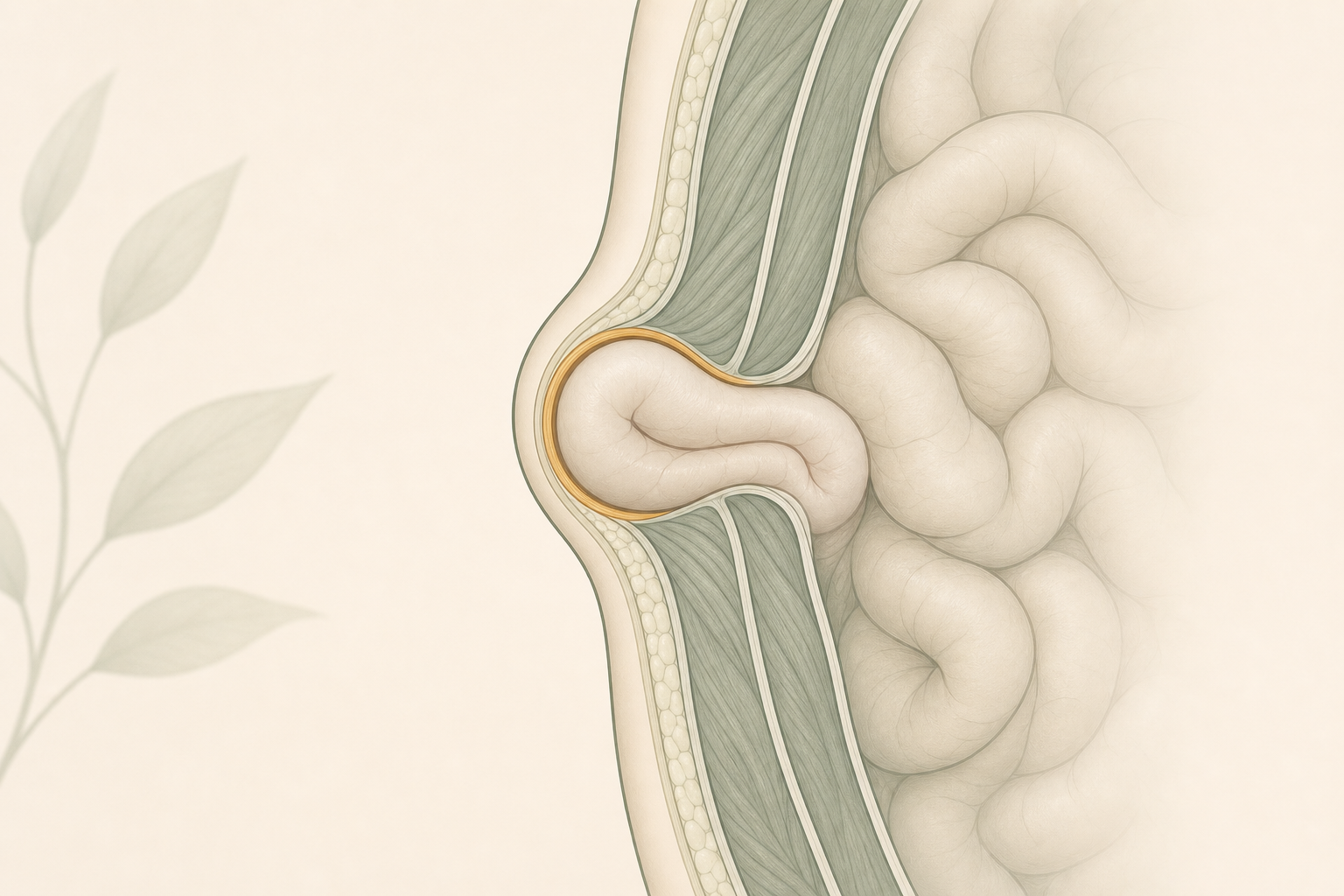
A gap at the navel that lets tissue push through from inside the abdomen.
The belly button sits over a natural weak point in the abdominal wall, where the umbilical cord once passed through. When that gap widens, fatty tissue or a loop of bowel can push through it, and you see or feel a soft bulge at or beside the navel. It often becomes more obvious when you stand, cough, laugh, or strain, and flattens when you lie down.
In babies these hernias often close by themselves. In adults they do not. An adult umbilical hernia tends to enlarge slowly over the years, which is why the honest answer is rarely to ignore it and always to understand it. Dr Lee assesses the size of the defect, what is coming through it, and how it behaves, then talks you through the options without pressure.
The classic navel bulge
A soft swelling at or just beside the belly button that appears with standing or straining and often disappears when lying flat. Usually painless at first, though many people feel a dragging ache by the end of the day.
Who tends to develop one
Anything that raises pressure inside the abdomen over time plays a part: pregnancy, being overweight, a chronic cough, repeated heavy lifting, or fluid in the abdomen. Some people simply have a wider natural gap.
Paraumbilical hernia
In adults the defect often sits just above or below the navel rather than through its centre. These behave the same way and are assessed and repaired on the same principles.
Why adults are different from babies
An infant's umbilical ring usually closes on its own in the first years of life. An adult's does not, so the question is not whether it will heal by itself, but whether and when it should be repaired.
When to see a surgeon, and when it should not wait.
Most umbilical hernias can be assessed calmly, at a time that suits you. A few situations deserve prompt attention, because a hernia that traps its contents can cut off their blood supply.
- A navel bulge that is getting larger or more uncomfortable over time
- Aching, dragging, or a feeling of pressure at the belly button after standing or exertion
- A bulge you used to be able to push back that no longer goes in
- Skin over the bulge becoming thin, stretched, or irritated
- You are planning pregnancy or surgery and want the hernia dealt with first
A hard, painful bulge that will not go back needs to be seen the same day.
If the bulge becomes firm, very painful, or discoloured, cannot be pushed back in, or comes with nausea, vomiting, or a bloated abdomen, the hernia may be strangulating, which means the tissue inside is losing its blood supply. That is an emergency. Go to a hospital emergency department without delay rather than waiting for a clinic appointment.

Repairing the gap, with the technique matched to the hernia.
Small, soft, easily reducible umbilical hernias that cause no symptoms can sometimes be observed, and Dr Lee will say so plainly when that is a reasonable path. When repair is advised, the operation closes the defect, either with stitches alone for small gaps or with a mesh reinforcement for larger ones, so the weak point is supported rather than simply pulled together under tension.
Repair can be done through a small cut at the navel or by keyhole surgery, depending on the size of the defect, your build, and whether anything else needs attention at the same time. Most umbilical hernia repairs are day procedures. Dr Lee explains the recommended approach, and the reason for it, before anything is scheduled.
- Examination of the bulge standing and lying down, to judge the size of the defect and what is coming through
- An honest conversation about observation versus repair for your specific hernia
- Stitch or mesh repair, open or keyhole, chosen for the defect rather than by default
- A clear plan for the day of surgery, usually as a day procedure
Read more about the operation itself, including open versus keyhole repair, on the hernia surgery in Singapore page.
A surgeon who built care around older patients.
Many umbilical hernias are repaired in patients in their sixties, seventies, and beyond, and the sensible questions change with age: is surgery safe for my parent, and is repair worth it at all? As the former Surgical Lead for Geriatric Surgery at Khoo Teck Puat Hospital, Dr Lee developed assessment and recovery pathways designed around older patients, and co-authored a 2024 review in the Journal of Gastrointestinal Surgery on how surgeon-led geriatric care drives good outcomes in older patients undergoing abdominal surgery.
For families weighing up a repair for a parent, that experience shapes both the advice and the operation itself. More about Dr Lee's background and approach.

Back on your feet quickly, with the wound respected.
Most repairs are day surgery
You typically go home the same day. Discomfort around the navel is expected for the first days and is managed with simple pain relief. Most people are walking comfortably almost immediately.
A staged return to activity
Desk work is usually possible within days. Heavy lifting and straining are held back for several weeks so the repair can heal properly. Dr Lee gives you specific timelines for your work and exercise rather than a generic list.
Protecting the repair
Keeping weight steady, treating a chronic cough, and avoiding repeated straining all lower the pressure on the repair. These are discussed as part of the plan, not left for you to guess.
Clear fees for umbilical hernia repair, with MediSave and insurance guidance.
Your exact fee is explained clearly at consultation, before anything is scheduled. As a public reference point, the Ministry of Health publishes fee benchmarks for the doctors involved in umbilical or upper-abdomen hernia repair, procedure code SF814A. The figures below are those benchmarks, with GST. They are a guide, not a quotation.
| What makes up your bill | MOH fee benchmark (with GST) |
|---|---|
| Surgeon feeumbilical or epigastric hernia repair, SF814A | SGD 3,270 to 5,341 |
| Anaesthetist feesame procedure, SF814A | SGD 1,199 to 1,962 |
| Hospital or day-surgery facility feeno MOH doctor-fee benchmark applies | Varies by hospital, quoted before scheduling |
These are published fee benchmarks, before MediSave and insurance. Umbilical hernia repair is typically MediSave claimable and is usually covered by Integrated Shield Plans, so most insured patients pay much less out of pocket. The team works out your likely cost with you before anything is scheduled.
You can check these figures against the published MOH fee benchmark page.
Umbilical hernia repair is typically a day procedure. The facility fee depends on the hospital and on your ward or day-surgery choice, so it is quoted to you directly rather than benchmarked.
Use what you are entitled to
Hernia repair is a MediSave-claimable surgical procedure, subject to the applicable withdrawal limits. The team helps you apply it correctly.
Often covered by your plan
Day-surgery hernia repair is usually covered under Integrated Shield Plans. The team helps you understand what your plan covers before anything is scheduled.
We handle the claim
The team assists with the forms and liaises with your insurer where possible, so the administrative side is as straightforward as the consultation.
Fee benchmark figures are the Ministry of Health (Singapore) surgeon and anaesthetist fee benchmarks for procedure SF814A, with GST, and are a public guide, not a quotation.
The plans we work with.
Dr Daniel Lee practises with Colorectal Clinic Associates (CCA). The clinic works with the insurers below, and the team assists with claims and eligibility checks.






















Umbilical hernia in Singapore, answered plainly.
Will my umbilical hernia go away on its own?
Is it dangerous to leave an umbilical hernia alone?
Do all umbilical hernias need mesh?
Can an umbilical hernia be repaired as day surgery?
I noticed the bulge during or after pregnancy. Is that normal?
Will MediSave or my insurance cover the repair?
Umbilical hernia assessments across five private hospitals.
Related conditions and treatments.
A short message is enough to begin.
Whether the bulge is new or something you have quietly watched for years, send a note with your name, number and what you are noticing. Dr Lee's team will reply on WhatsApp and arrange a time and location that suits you.